
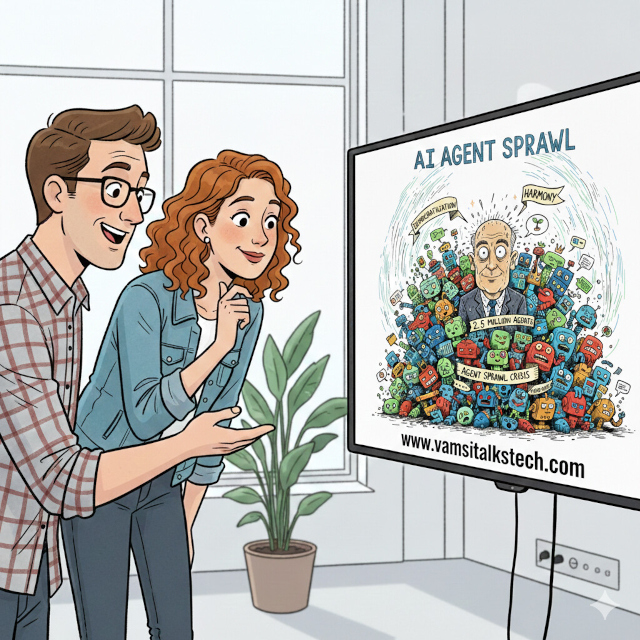
As mentioned in the last blog, in the summer of 2025, SoftBank Corp. achieved what many considered impossible: engaging every employee in AI adoption at scale, resulting in 2.5 million AI agents created in just ten weeks. The initiative was hailed as a triumph of democratization, a masterclass in organizational change management, and proof that cultural transformation could happen faster than most enterprises imagined. But beneath the celebration lies a more complex reality—one that reveals a fundamental tension at the heart of enterprise AI adoption. SoftBank may have solved the adoption problem only to create a far more insidious challenge: agent sprawl.
The Paradox of Democratization
The promise of democratized AI is intoxicating. When every employee can create agents tailored to their specific workflows, organizations unlock unprecedented innovation capacity. Domain experts who understand nuanced business processes can automate tasks without waiting for IT approval or technical specialists. The barriers between problem identification and solution implementation collapse. This is the vision that drove SoftBank’s initiative and countless similar efforts across the enterprise landscape.
But democratization without governance is chaos with a better marketing message. When 25,000 employees each create 100 agents with minimal oversight, the result isn’t an elegant AI-powered organization—it’s a sprawling ecosystem of redundant, inconsistent, and potentially conflicting automation that no one fully understands. The same forces that enable rapid innovation also enable rapid entropy.
Consider the mathematics of the problem. SoftBank’s 2.5 million agents represent an average of 100 agents per employee. Even assuming significant overlap in use cases, the organization likely has hundreds or thousands of agents performing functionally similar tasks with different logic, different data sources, and different quality standards. A sales representative in Tokyo might create an agent to summarize customer calls, while another in Osaka builds a nearly identical agent with slightly different prompts. Multiply this across departments, regions, and functions, and the duplication becomes staggering.
The Hidden Costs of Agent Proliferation
Agent sprawl manifests as a multi-dimensional crisis that compounds over time, eroding the very efficiency gains AI promises to deliver.
Operational Inefficiency: When employees spend more time searching for existing agents than creating new ones, productivity gains evaporate. The cognitive overhead of navigating thousands of agents—understanding what each does, which are reliable, which are deprecated—becomes a tax on every AI interaction. Organizations that celebrated eliminating manual processes find themselves creating new forms of manual work: agent discovery, agent evaluation, agent selection.
Knowledge Fragmentation: In a well-architected AI system, common patterns are abstracted into reusable components. Agent sprawl does the opposite—it embeds knowledge in thousands of individual agents, making it nearly impossible to update logic systematically. When business rules change or new regulations emerge, organizations face the Sisyphean task of identifying and updating countless agents rather than modifying a centralized pattern. Knowledge becomes trapped in a distributed network that resists consolidation.
Quality Degradation: Without systematic review processes, agent quality varies wildly. Some agents are carefully crafted with robust error handling and clear documentation. Others are hastily assembled experiments that somehow made it into production use. Users have no reliable way to distinguish between them, leading to inconsistent outputs, eroded trust, and the gradual abandonment of AI tools in favor of manual processes that at least offer predictable results.
Security and Compliance Risks: Every agent represents a potential security vulnerability or compliance violation. Agents that access sensitive data, make automated decisions, or interact with external systems require careful review. But when agents proliferate faster than governance processes can scale, organizations lose visibility into their own AI footprint. Which agents have access to customer data? Which are making decisions that require audit trails? Which are using deprecated APIs or violating data residency requirements? In an agent sprawl environment, these questions become nearly impossible to answer.
Computational Cost Spiral: Each agent consumes computational resources—API calls, processing time, storage. When thousands of redundant agents perform similar tasks, costs multiply unnecessarily. Organizations that expected AI to reduce operational expenses find themselves with ballooning infrastructure bills and no clear path to optimization. The economic case for AI adoption weakens as the cost-per-task increases rather than decreases with scale.
Organizational Confusion: Perhaps most insidiously, agent sprawl creates a fog of uncertainty about what the organization’s AI is actually doing. Leadership loses the ability to understand their AI capabilities, making strategic decisions about AI investment nearly impossible. How do you prioritize AI initiatives when you can’t inventory existing capabilities? How do you measure ROI when you can’t track which agents are delivering value? How do you plan for the future when you can’t see the present?
The Lifecycle Management Gap
The fundamental problem is that most organizations approach AI agents as if they were documents or emails—artifacts that individuals create and manage independently. But agents are more like applications: they require versioning, testing, monitoring, deprecation, and ongoing maintenance. Without proper lifecycle management, agents become technical debt that accumulates faster than organizations can service it.
Consider the typical lifecycle of an agent in a sprawl environment. An employee creates an agent to solve an immediate problem. It works well enough, so they share it with colleagues. Others copy and modify it for their own needs. The original creator moves to a different role or leaves the company. The agent continues running, but no one remembers exactly what it does or why certain logic was implemented. When it breaks or produces unexpected results, no one knows how to fix it. Eventually, users work around it, but it continues consuming resources because no one has the authority or knowledge to decommission it.
Multiply this scenario across thousands of agents, and the scale of the problem becomes clear. Organizations need systematic approaches to agent lifecycle management that include creation standards, review processes, versioning systems, usage monitoring, performance tracking, and deprecation workflows. Without these foundations, agent sprawl is inevitable.
The Governance Imperative
Addressing agent sprawl requires a fundamental shift in how organizations think about AI governance. The goal isn’t to eliminate democratization—the innovation benefits are too significant—but to implement governance frameworks that enable democratization while preventing chaos.
Agent Registries and Discovery: Organizations need centralized systems that catalog every agent, its purpose, its creator, its dependencies, and its usage patterns. This isn’t just documentation—it’s the foundation for everything else. Without knowing what agents exist, organizations can’t manage them effectively. Modern agent registries should include semantic search capabilities that help users find existing agents before creating new ones, reducing redundant development.
Quality Tiers and Certification: Not all agents need the same level of rigor, but users need to understand what they’re working with. Organizations should implement tiered systems that distinguish between experimental agents (use at your own risk), departmental agents (reviewed and approved for specific teams), and enterprise agents (rigorously tested and supported for company-wide use). Clear certification processes help users make informed decisions and create incentives for quality improvement.
Automated Monitoring and Alerting: Agents should be instrumented to report usage, performance, errors, and resource consumption. Automated monitoring systems can identify agents that are failing frequently, consuming excessive resources, or sitting idle. This data enables proactive management rather than reactive firefighting.
Consolidation and Refactoring: Organizations need systematic processes for identifying redundant agents and consolidating them into reusable patterns. This requires dedicated resources—teams responsible for analyzing agent usage, identifying common patterns, and building enterprise-grade versions that replace sprawling collections of individual agents. It’s the AI equivalent of technical debt reduction, and it requires ongoing investment.
Access Controls and Security Review: Not every employee should be able to create agents that access sensitive data or make automated decisions with significant business impact. Role-based access controls and mandatory security reviews for high-risk agents are essential. This doesn’t mean blocking innovation—it means ensuring that innovation happens within appropriate guardrails.
Deprecation Workflows: Agents should have explicit lifecycles with sunset dates. When agents are no longer needed or have been superseded by better alternatives, they should be systematically decommissioned. This requires communication with users, migration support, and the authority to actually turn agents off rather than letting them accumulate indefinitely.
The Architectural Solution: From Agents to Agent Platforms
The long-term solution to agent sprawl isn’t better governance of individual agents—it’s evolving from agent proliferation to agent platforms. Rather than thousands of bespoke agents, organizations should build reusable agent frameworks that employees can configure rather than create from scratch.
This architectural shift mirrors the evolution of enterprise software. Early organizations let every department build custom applications, leading to sprawl and integration nightmares. Modern enterprises use configurable platforms that provide common capabilities while allowing customization. The same pattern applies to AI agents.
An agent platform approach provides pre-built components for common tasks—data retrieval, summarization, analysis, notification—that employees can combine and configure without writing agents from scratch. This dramatically reduces redundancy while maintaining flexibility. Instead of 1,000 employees each creating a meeting summarization agent, they configure a centralized meeting summarization service with their specific preferences.
Platform approaches also enable systematic improvements. When the underlying summarization model improves, all users benefit automatically rather than requiring individual agent updates. When security requirements change, platform-level controls can be implemented once rather than across thousands of agents.
Learning from Software Engineering
The agent sprawl crisis isn’t unprecedented—it’s a replay of challenges software engineering solved decades ago. Early software development was characterized by individual developers creating custom solutions with minimal coordination, leading to unmaintainable codebases. The industry responded with version control, code review, testing frameworks, continuous integration, and architectural patterns that enabled collaboration at scale.
Enterprise AI needs to learn these lessons rather than repeating them. The practices that enable software engineering teams to manage millions of lines of code—modular design, reusable components, automated testing, systematic review—apply equally to AI agents. Organizations that treat agent development as a software engineering discipline rather than an individual productivity hack will avoid the worst effects of sprawl.
This means investing in AI engineering capabilities: teams that understand both AI and software engineering, tools that support agent development workflows, and processes that balance innovation with sustainability. It means recognizing that democratization without engineering discipline creates problems faster than it solves them.
The SoftBank Reckoning
SoftBank’s initiative brilliantly demonstrated that cultural transformation around AI can happen quickly when organizations commit fully. The 90% positive sentiment and widespread adoption are genuine achievements that many enterprises would envy. But the initiative also revealed the limits of adoption-focused strategies that don’t adequately address sustainability.
The next chapter of SoftBank’s AI journey will likely involve significant investment in consolidation, governance, and platform development. The organization will need to identify which of those 2.5 million agents are delivering real value, consolidate redundant capabilities, deprecate failed experiments, and build systematic approaches to agent management. This work is less exciting than the initial creation sprint, but it’s essential for long-term success.
The question is whether SoftBank recognized this challenge from the beginning and planned for it, or whether they’re now discovering the agent sprawl problem as usage scales. The answer will determine whether their initiative becomes a cautionary tale or a blueprint for sustainable AI adoption.
Implications for Enterprise AI Strategy
For organizations watching SoftBank’s experiment and considering similar initiatives, the lesson isn’t to avoid democratization—it’s to plan for sprawl from the beginning. Successful enterprise AI strategies must balance three competing imperatives: enabling innovation through democratization, maintaining quality and security through governance, and ensuring sustainability through proper lifecycle management.
This requires upfront investment in infrastructure that many organizations are tempted to defer. Building agent registries, implementing monitoring systems, and establishing governance processes feels like overhead when the priority is driving adoption. But deferring these investments doesn’t eliminate the need—it just ensures that organizations will address them later under crisis conditions with accumulated technical debt.
Organizations should also set realistic expectations about agent creation velocity. SoftBank’s “100 agents per employee” target drove impressive adoption, but it also incentivized quantity over quality. A more sustainable approach might target fewer, better agents with proper documentation, testing, and review. The goal should be creating agents that deliver lasting value, not hitting arbitrary creation metrics.
The Path Forward
Agent sprawl is not an inevitable consequence of AI democratization—it’s a consequence of democratization without adequate governance and architectural planning. Organizations that recognize this distinction can capture the innovation benefits of widespread AI adoption while avoiding the chaos of unmanaged proliferation.
The solution requires simultaneous investment in three areas: governance frameworks that provide visibility and control without stifling innovation, platform architectures that reduce redundancy through reusable components, and engineering practices that treat agents as software artifacts requiring proper lifecycle management.
Organizations that get this balance right will achieve what SoftBank demonstrated is possible—rapid, widespread AI adoption—while avoiding the agent sprawl crisis that threatens to undermine those gains. Those that focus exclusively on adoption without addressing sustainability will find themselves trapped in a cycle of creation and cleanup, never quite achieving the productivity transformation AI promises.
The agent sprawl problem is ultimately a maturity challenge. Early-stage AI adoption prioritizes experimentation and learning, accepting some chaos as the cost of cultural transformation. But mature AI organizations must evolve beyond experimentation to systematic management, treating AI as critical infrastructure rather than individual productivity tools.
SoftBank’s initiative marks the end of the beginning for enterprise AI adoption. The next phase—building sustainable, governed, architected AI capabilities at scale—will determine which organizations truly transform and which simply accumulate technical debt with better marketing. The companies that solve agent sprawl won’t just have more AI—they’ll have better AI, and that difference will define competitive advantage in the AI era.
Conclusion
The irony is that the solution to agent sprawl requires exactly the kind of centralized planning and systematic thinking that democratization was meant to escape. But this isn’t a contradiction—it’s a maturity model. Successful enterprises don’t choose between innovation and governance; they build systems that enable both. The question isn’t whether to democratize AI, but how to democratize it sustainably. SoftBank showed us the power of the former. The industry is still learning the latter.