
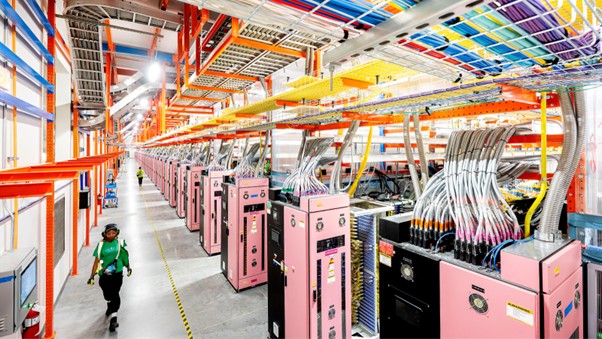
Project Rainier is an AI supercomputing cluster distributed across multiple U.S. data centers, designed to provide infrastructure for training large AI models. The project is a collaboration between AWS and Anthropic, with AWS investing to provide Anthropic with compute capacity for developing future versions of the Claude AI model. The cluster uses a distributed architecture across geographically dispersed data centers, providing scalability and redundancy compared to traditional centralized supercomputers. (https://www.aboutamazon.com/news/aws/aws-project-rainier-ai-trainium-chips-compute-cluster)
Project Rainier
In the words of NY Times – Project Rainier is Amazon’s entry into a race by the technology industry to build data centers so large they would have been considered absurd just a few years ago. Meta, which owns Facebook, Instagram and WhatsApp, is building a two-gigawatt data center in Louisiana. OpenAI is erecting a 1.2-gigawatt facility in Texas and another, nearly as large, in the United Arab Emirates.
These data centers will dwarf most of today’s, which were built before OpenAI’s ChatGPT chatbot inspired the A.I. boom in 2022. The tech industry’s increasingly powerful A.I. technologies require massive networks of specialized computer chips — and hundreds of billions of dollars to build the data centers that house those chips. The result: behemoths that stretch the limits of the electrical grid and change the way the world thinks about computers. Amazon, which has invested $8 billion in Anthropic, will rent computing power from the new facility to its start-up partner. An Anthropic co-founder, Tom Brown, who oversees the company’s work with Amazon on its chips and data centers, said having all that computing power in one spot could allow the start-up to train a single A.I. system.
“If you want to do one big run, you can do it,” he said.
Trainium2: The Heart of Project Rainier

(Trainum 2 – Credit NYTimes)
The Trainium2 chips are AWS-designed processors built to handle AI training and inference workloads. AWS developed these chips to reduce dependence on external GPU providers while offering cost-competitive performance.
Technical Specifications
The Trainium2 chip specifications include:
– Compute Performance: 650 TFLOPS of BFloat16 performance and up to 1.3 PetaFLOPS of FP8 performance
– Memory: 96 GB of HBM3e memory per chip
– Interconnect: NeuronLink 3.0 with 3D torus network topology for inter-chip communication
– Cost Efficiency: AWS claims 30-40% better price-performance compared to Nvidia GPUs
– Design: Optimized for both training and inference workloads, with support for sparse operations.
The Trainium2 chip, a second-generation machine learning accelerator from AWS, represents a significant leap forward in custom silicon designed specifically for artificial intelligence workloads. Its technical specifications highlight a strong focus on high performance, efficient memory management, and scalable interconnectivity, all while aiming for superior cost-effectiveness compared to industry-standard GPUs.
At the core of Trainium2’s capabilities is its impressive Compute Performance. It delivers 650 TFLOPS (TeraFLOPS) of BFloat16 performance, a common and efficient format for deep learning training. For even greater acceleration, it can achieve up to 1.3 PetaFLOPS (PetaFLOPS) of FP8 performance. The inclusion of FP8, a lower precision floating-point format, is particularly relevant for inference workloads and certain training scenarios where reduced precision can significantly boost speed without sacrificing accuracy, showcasing its versatility for a range of AI tasks.
Memory is another critical aspect where Trainium2 excels, packing 96 GB of HBM3e (High Bandwidth Memory 3e) per chip. HBM3e is a cutting-edge memory technology known for its exceptionally high bandwidth, which is crucial for feeding the massive amounts of data required by large-scale AI models to the compute units efficiently. This generous memory capacity and speed help prevent bottlenecks, ensuring that the processing units are constantly supplied with data, leading to faster training and inference times.
For large-scale, distributed AI model training, the Interconnect plays a pivotal role. Trainium2 leverages NeuronLink 3.0, a high-speed, low-latency inter-chip communication fabric. Its 3D torus network topology is specifically designed for efficient data transfer and synchronization across multiple Trainium2 chips, enabling the construction of powerful supercomputing clusters for training models with billions or even trillions of parameters. This advanced interconnect ensures that even when scaling out to hundreds or thousands of chips, the overall system behaves as a cohesive unit, minimizing communication overhead.
A key differentiator and a significant selling point for AWS is the purported Cost Efficiency of Trainium2. AWS claims a 30-40% better price-performance ratio compared to Nvidia GPUs. This claim suggests that customers can achieve the same level of AI performance for a lower cost, or significantly more performance for the same cost, making advanced AI capabilities more accessible and economically viable for a broader range of enterprises and research institutions. This cost advantage can be a major factor for organizations managing large-scale AI infrastructure.
Finally, the Design philosophy behind Trainium2 emphasizes its optimization for both training and inference workloads. This dual-purpose design means that organizations do not necessarily need separate hardware infrastructures for developing and then deploying their AI models, streamlining operations and potentially reducing total cost of ownership. Furthermore, its support for sparse operations is a crucial feature. Many modern neural networks are becoming increasingly sparse, meaning that many of their parameters are zero. Hardware optimized for sparse operations can skip over these zero values, leading to significant performance gains and reduced memory usage, especially for large language models and other complex AI architectures.
In summary, the Trainium2 chip is positioned as a high-performance, cost-effective, and versatile accelerator, engineered to meet the demanding requirements of current and future artificial intelligence applications on the AWS cloud. Its specifications reflect a comprehensive approach to addressing the core challenges of AI development and deployment, from raw compute power and memory bandwidth to inter-chip communication and workload-specific optimizations.
Understanding UltraCluster Architecture
Project Rainier uses a hierarchical architecture called “EC2 UltraCluster of Trainium2 UltraServers.” Each UltraServer contains four physical servers, with each server housing 16 Trainium2 chips. These UltraServers connect via high-speed NeuronLink connections.UltraServers are the powerful AI training nodes at the core of Project Rainier, developed by AWS using its Trainium2 chips. These custom ASICs, designed by Annapurna Labs, are tailored for large-scale model training and are the foundation of AWS EC2 Trn2 instances and UltraClusters.
In the UltraCluster configuration, the system provides up to 332 petaflops of aggregate performance for sparse FP8 operations. The distributed design allows for component maintenance and upgrades without complete system downtime.
The UltraServer design tackles a major challenge in AI training: latency. Each UltraServer houses 64 Trainium2 chips and utilizes Amazon NeuronLink v2, AWS’s proprietary interconnect for chip-to-chip and server-to-server communication. Key enhancements in NeuronLink v2 include:
* Twice the bandwidth of the previous version
* Latency optimization for specific AI training stages
* Scalability to clusters with over 100,000 interconnected chips
AWS positions NeuronLink v2 as a superior alternative to Nvidia’s NVLink, with deeper integration into the AWS software and infrastructure stack. This allows for performance tuning at every system level. In the words of AWS –

Scale and Impact
By the end of 2025, Project Rainier is expected to contain over one million Trainium2 chips, making it one of the world’s largest AI compute facilities. This will provide Anthropic with approximately five times more compute power than its current largest training cluster.
The project represents AWS’s strategy to develop in-house silicon alternatives to reduce reliance on Nvidia, which currently dominates the AI accelerator market. This approach allows AWS to control costs and offer customers additional options for AI workloads.
Trainium3: Next Generation
AWS has announced the Trainium3 chip, expected in late 2025. Built on a 3-nanometer process, Trainium3 is designed to deliver four times the performance and 40% better energy efficiency compared to Trainium2. The improved energy efficiency addresses growing concerns about power consumption and cooling requirements for large-scale AI training operations.
Applications of Large-Scale AI Compute Clusters

Large AI compute clusters enable transformative applications across multiple industries, revolutionizing how organizations approach complex computational challenges and data analysis.
Healthcare and Medical Research
In the healthcare sector, large-scale AI compute clusters are driving unprecedented advances in medical research and patient care. Drug discovery processes have been revolutionized through sophisticated simulation of molecular interactions, enabling researchers to identify promising drug candidates and predict their efficacy with remarkable accuracy before costly laboratory testing. Genomics research has similarly benefited, with these powerful systems analyzing vast genetic datasets to identify disease markers that enable truly personalized medicine approaches. Medical imaging has seen dramatic improvements in diagnostic accuracy, as AI models trained on these clusters can detect diseases in medical images with precision that often exceeds human capabilities. Additionally, clinical trials have become more efficient and effective through AI-powered optimization of trial design and execution, reducing costs and accelerating the path to new treatments.
Scientific Research
The scientific research community has embraced large AI compute clusters to tackle some of humanity’s most pressing questions. Climate modeling has reached new levels of sophistication, with high-resolution simulations capable of predicting regional climate impacts with unprecedented detail and accuracy. Astrophysics research has been transformed by the ability to process massive amounts of observational data from telescopes and satellites, revealing new insights about our universe. Material science has particularly benefited from these computational resources, as researchers can now predict the properties of novel materials before physical synthesis, dramatically accelerating the development of new technologies and reducing research costs.
Financial Services
The financial services industry has leveraged large-scale AI compute clusters to enhance decision-making and risk management across multiple domains. Algorithmic trading systems now perform real-time market analysis and execute automated trading strategies with speed and precision impossible for human traders. Risk assessment has been revolutionized through sophisticated credit risk evaluation and fraud detection systems that can process vast amounts of transaction data in real-time. Economic forecasting has become more accurate and nuanced, with AI systems analyzing complex economic indicators to predict market trends and inform strategic business decisions.
Autonomous Systems
Large AI compute clusters are the backbone of the autonomous systems revolution, enabling machines to operate independently in complex environments. Self-driving vehicles rely on these powerful systems to train models that can process sensor data from cameras, lidar, and radar to navigate safely through unpredictable traffic conditions and weather scenarios. Industrial robotics has evolved beyond simple repetitive tasks, with AI-powered robots now capable of adapting to variable tasks and collaborating seamlessly with human workers in manufacturing and logistics environments.
Natural Language Processing
The field of natural language processing has been transformed by large-scale AI compute clusters, enabling more sophisticated and human-like interactions between people and machines. Translation systems now provide real-time language translation with dramatically improved accuracy, breaking down communication barriers across cultures and languages. Customer service has been enhanced through AI-powered chatbots and virtual assistants that can understand context, emotion, and intent to provide more helpful and personalized support. Content analysis capabilities have expanded to include sophisticated sentiment analysis and large-scale text processing, enabling organizations to understand public opinion and extract insights from vast amounts of textual data.
Energy and Sustainability
Large AI compute clusters are playing a crucial role in addressing global energy challenges and promoting sustainability. Smart grid systems utilize these computational resources for real-time optimization of energy distribution and consumption, reducing waste and improving efficiency across electrical networks. Renewable energy forecasting has become more accurate and reliable, with AI systems predicting solar and wind energy output to enable better grid integration and energy storage planning, ultimately supporting the transition to cleaner energy sources.
Creative Industries
The creative industries have discovered innovative applications for large-scale AI compute clusters that are reshaping how content is created and consumed. AI-assisted creation of music, visual art, and written content is opening new possibilities for artists and creators, providing tools that can inspire and enhance human creativity rather than replace it. Virtual and augmented reality experiences have become more sophisticated and immersive through the development of interactive experiences that require massive computational power to render realistic environments and respond to user interactions in real-time.
Conclusion
By controlling the entire stack—from silicon and software to the power grid—AWS aims to deliver cost, performance, and sustainability benefits. These factors will increasingly distinguish market leaders from the competition. Ultimately, Project Rainier underscores a fundamental shift: the frontier of AI is no longer solely defined by the secret sauce (i.e algorithms), but by the infrastructure that supports them. In today’s market, this infrastructure is being specifically designed at hyperscale.